


 Italiano
Solo Mining Calculator
Pick your machine from the dropdown, or choose Custom Hashrate and enter your fleet’s combined figure, and this solo mining calculator works out your real chance of finding a block over a month, a year and three years. Everything recalculates against live network hashrate, difficulty and price, so the solo mining odds you see reflect the network as it stands right now rather than a figure copied from an article written two years ago.
If you run more than one machine, add their hashrates together and enter the total. Solo mining odds combine cleanly across a fleet, because every miner searches its own portion of the space independently — four 1.2 TH/s machines give you the same odds as a single 4.8 TH/s one.
Smart Mining Calculator


Odds are statistical estimates based on current live network hashrate and difficulty, assuming 100% uptime. When dual-mining is enabled, total hashrate is divided between BTC and BCH according to the slider above. Actual results vary — solo mining outcomes are probabilistic, not guaranteed.
What you win, and for how much longer
Your odds are only half of the picture. The other half is what you actually win, and that number is not fixed forever. The current Bitcoin block reward is 3.125 BTC, but it is cut in half roughly every four years by a rule written into the protocol itself.
When that happens, every figure above stays exactly the same while the prize behind it halves. The countdown below tracks the next Bitcoin halving and the next Bitcoin Cash halving from live block height rather than a calendar date — because the halving happens at a block number, not on a day someone chose.
Block Halving Countdown
Countdown based on live block height vs. the fixed halving height of 1,050,000 for both networks, using each network's recent average block time. Estimated dates will shift slightly as block production speeds up or slows down.
How this solo mining calculator works out your odds
The arithmetic behind solo mining is simpler than most people expect, and understanding it makes the results far more useful than just reading the percentage.
The Bitcoin network produces a block roughly every ten minutes. Your probability of being the miner who finds any given block is your hashrate divided by the total hashrate of the network. If the network is running at 800 EH/s and your machine does 12 TH/s, you own about one 66-millionth of the global search effort, and that is your chance in each block.
Over a longer period the solo mining calculator compounds that per-block chance across every block the network will produce in the window. That is why the month, year and three-year figures do not simply multiply by twelve and thirty-six — each additional block is another independent attempt, and the maths of “at least once” is not linear.
Two inputs come from the live network rather than from us: the current network hashrate, and the current difficulty. Both move constantly. Network hashrate has trended upwards for most of Bitcoin’s history, which means that if you leave a machine running for three years, your real odds will drift slightly below what the calculator shows today. It assumes the network stays as it is, because nobody can honestly forecast where it goes.
Reading your solo mining odds over three time horizons
This solo mining calculator gives you solo mining odds per month, per year and per three years for a reason. A single month rarely tells you anything useful at home-mining scale, and a three-year figure is the one that reflects how people actually use these machines — plugged in and left alone.
Read the numbers as what they are: the probability of finding at least one block in that window. A one-in-several-thousand chance over three years is not a prediction that you will wait several thousand years. It means that out of everyone running an identical setup for three years, roughly one in that many will hit a block, and there is no way to know in advance who.
It also means the outcome is genuinely binary. There is no partial credit in solo mining, no gradual accumulation, and no consolation payout. Either your machine finds a block and takes the entire reward, or it does not.
The current Bitcoin block reward and the Bitcoin Cash block reward
Both panels show the live euro value of what a successful block pays, because the reward is denominated in coin but spent in currency.
The current Bitcoin block reward is 3.125 BTC. That figure has been in place since the April 2024 halving and will hold until the next one. On top of it, the winning miner also collects the transaction fees from that block, which the calculator does not include — so treat the reward figure as the floor rather than the ceiling.
The Bitcoin Cash block reward is also 3.125 BCH, following the same schedule and the same rules. The coins are worth very different amounts, which is why both panels convert to euro at the live price.
Why the Bitcoin Cash block reward is easier to win
This is the single most useful thing on the page for most home miners, and it is worth stating plainly.
Bitcoin and Bitcoin Cash use the identical SHA-256 algorithm, so the same hardware does the same work on either chain with no modification. What differs enormously is how much competition you face. The Bitcoin Cash network operates at a small fraction of Bitcoin’s total hashrate, so the same machine represents a far larger share of it.
Run the calculator both ways and the difference is stark. Your odds on Bitcoin Cash are better than your odds on Bitcoin by a wide margin — not because the machine works harder, but because there are fewer people in the draw.
The trade-off is what the two prizes are worth. Bitcoin’s reward is worth substantially more in euro terms. So the honest summary is: one very large prize you are unlikely to win, and one smaller prize you have a realistically better chance of winning, from exactly the same electricity.
Dual mining and the split slider
If your hardware supports it, switch on “Simultaneously mine Bitcoin and Bitcoin Cash” in the solo mining calculator and a slider appears that divides your hashrate between the two chains.
The slider does what it says: at 50/50, half your hashrate searches for Bitcoin blocks and half for Bitcoin Cash blocks, and both sets of odds fall accordingly. It is a genuine division, not a bonus. What makes it worth doing is that the two prizes are not equally hard to win, so splitting can raise your overall chance of winning something without changing your electricity bill at all.
Try the extremes. Push it fully to BCH and watch your Bitcoin Cash odds climb; pull it fully to BTC and watch them collapse while your Bitcoin odds recover. Somewhere in between is the balance that matches how you feel about a small chance at a large prize versus a better chance at a smaller one. There is no objectively correct setting — it is a preference, and this solo mining calculator exists so you can see the shape of the trade before you commit.
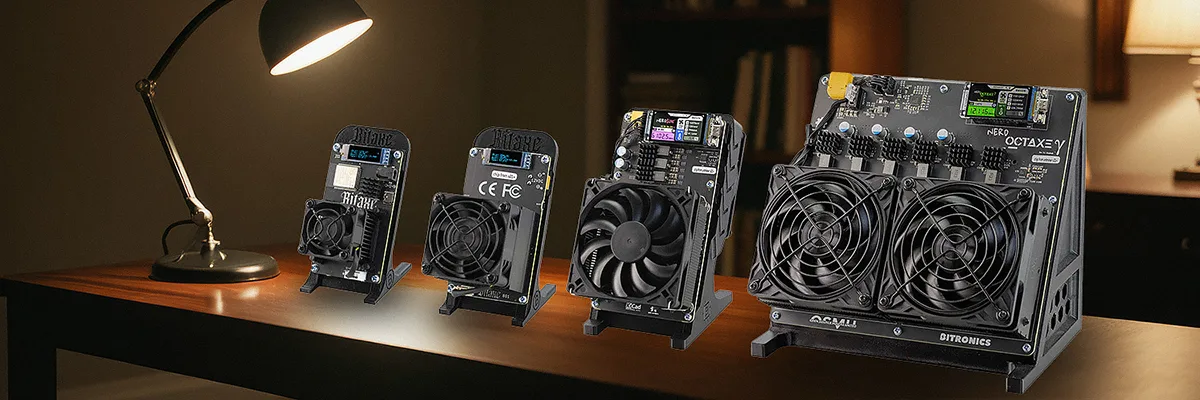
The two smaller machines in our range mine one chain at a time, so for those you would set the slider to whichever chain you have chosen. The two larger machines mine both at once, dividing their hashrate between the two chains with no overhead loss.
Understanding the Bitcoin halving countdown
The halving countdown above tracks both networks toward block 1,050,000, the height at which the next reduction takes effect.
A halving is not a market event or a policy decision. It is a line in the protocol: at fixed block intervals, the reward paid to miners is cut exactly in half. It has happened at every scheduled point since 2012 and it will continue until the last fraction of a bitcoin is issued somewhere around 2140.
The counter works from live block height rather than a fixed date. Blocks do not arrive on a perfect schedule — the network targets ten minutes but individual blocks land faster or slower depending on how much hashrate is online — so the estimated date shifts slightly as conditions change. The blocks-remaining figure is the reliable number; the date is a projection from recent average block time.
After the Bitcoin halving, the reward drops from 3.125 BTC to 1.5625 BTC. The Bitcoin Cash halving does the same on its own network, dropping from 3.125 BCH to 1.5625 BCH. Both are already scheduled: the Bitcoin halving and the Bitcoin Cash halving each trigger at block 1,050,000 on their own chain, which is exactly what the counter above is counting towards.
For a solo miner, the practical effect is straightforward and slightly uncomfortable: your odds of finding a block do not change at all, but the prize is worth half as much in coin terms. Whether that matters depends entirely on what happens to price, which nobody can tell you.
What this solo mining calculator deliberately does not do
It does not show projected earnings, and that is not an oversight.
Any tool that tells you a solo miner will earn a specific amount per month is either quietly modelling pool payouts — which is a completely different activity with a completely different risk profile — or inventing a number. Solo mining has no monthly income. It has a probability and a prize, and this page shows you both without wrapping them in a forecast.
The figures also assume 100% uptime. A machine that spends a fortnight switched off, or hours a week disconnected from its pool, is not entering those draws. Nothing else in your setup matters as much as simply leaving it running.
Finally, the odds carry no memory. Running for two years without finding a block does not make year three more likely. Every block is an independent event, which is the same reason nobody can promise you a result and the same reason your chance never runs out.
Turning the numbers into a decision
Once you have your odds in front of you, the decision usually resolves into one of three shapes.
If the three-year figure looks reasonable to you and the electricity cost is comfortable, you have found your machine. Most people start with one of the smaller miners for exactly this reason — the running cost is a few euro a month, and the odds are real.
If the odds look thin, the honest options are more hashrate or better odds on the smaller chain. Compare what each model does to the numbers before spending more, because the relationship is linear: doubling your hashrate doubles your chance, no more and no less.
And if you are weighing whether to add a second machine or replace your current one with something larger, the solo mining calculator answers that directly. Enter the combined hashrate as a custom figure — two machines running side by side give you exactly the odds of one machine with their total hashrate, so buying incrementally costs you nothing in probability.
When you have a figure you are happy with, the comparison table shows which machine produces it, and what it costs to run.