


 Italiano
Overview of Crypto Miners
Compare the best crypto miners for mining at home
Bitcoin mining moved into industrial data centres more than a decade ago, and for most people that was the end of it. It does not have to be. Every crypto mining machine in the table below is small enough to sit on a desk, quiet enough to live in a room you actually use, and draws less power than most kitchen appliances — yet each one competes on exactly the same network as the warehouses in Texas and Kazakhstan.
These four crypto miners share the same silicon. What separates them is scale: how many chips are working for you, how much electricity they consume, and how much noise they make while doing it. Compare the numbers below, then read on for what each row of that table actually means when you are mining at home.
| Product | ||||
|---|---|---|---|---|
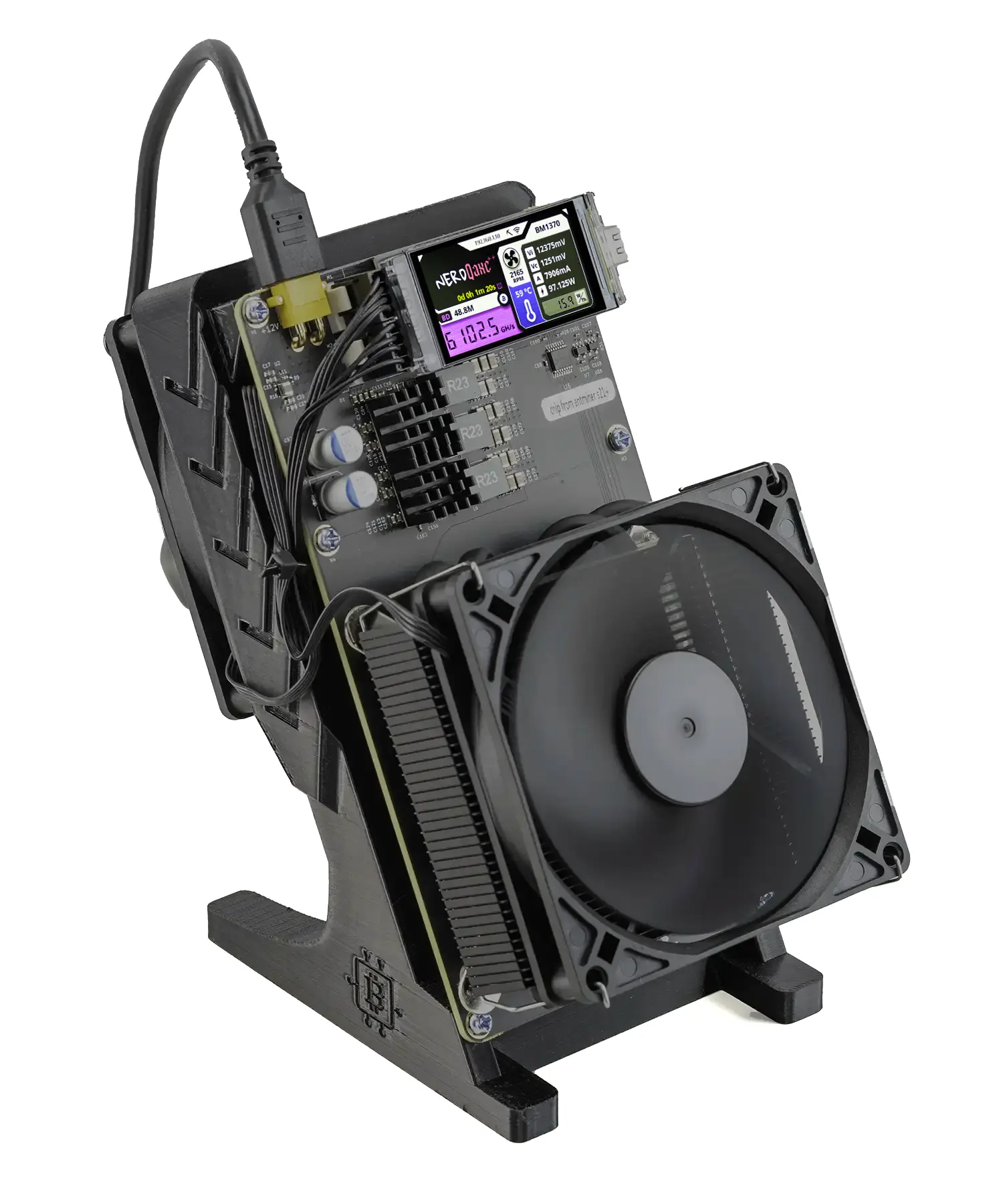
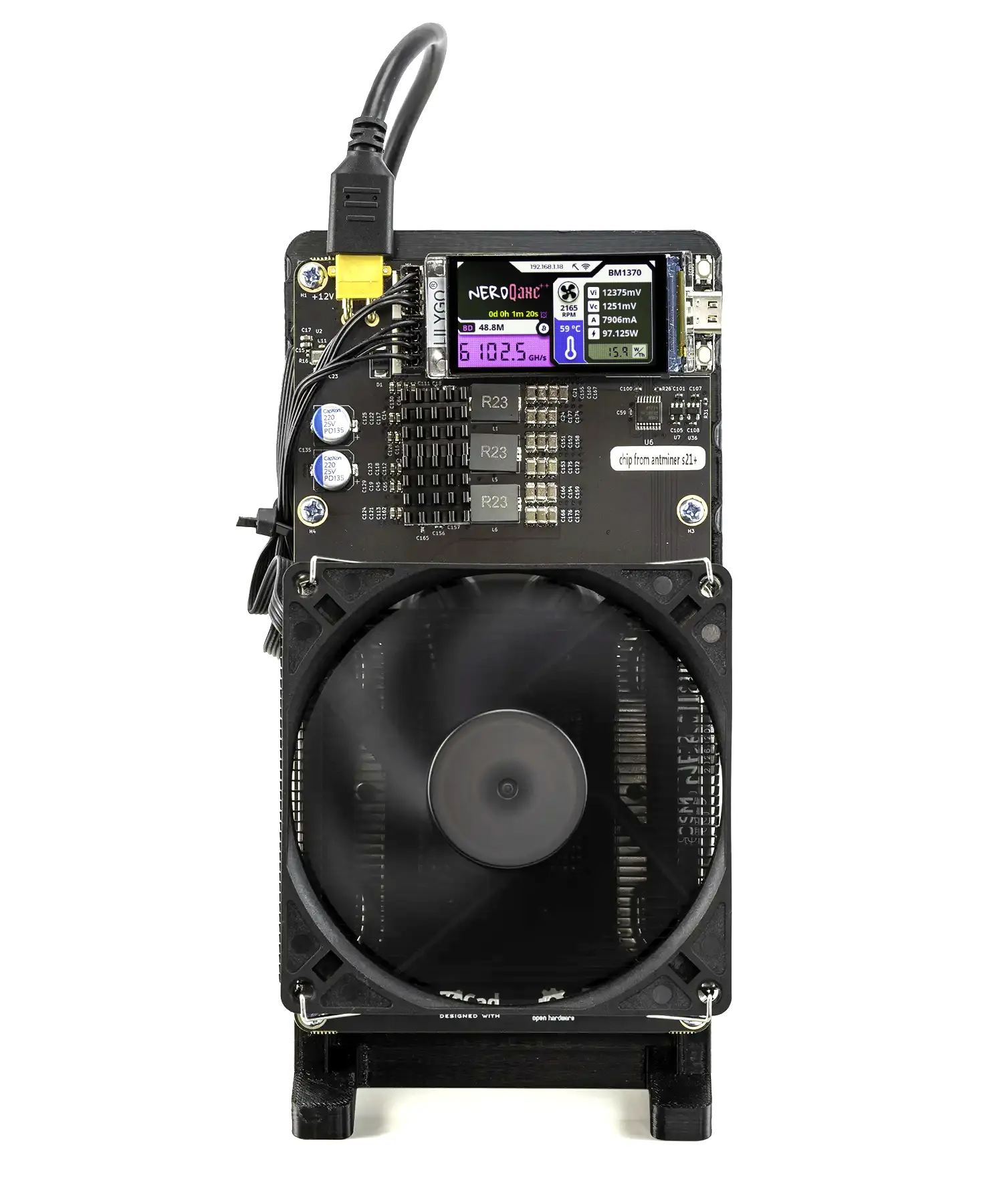
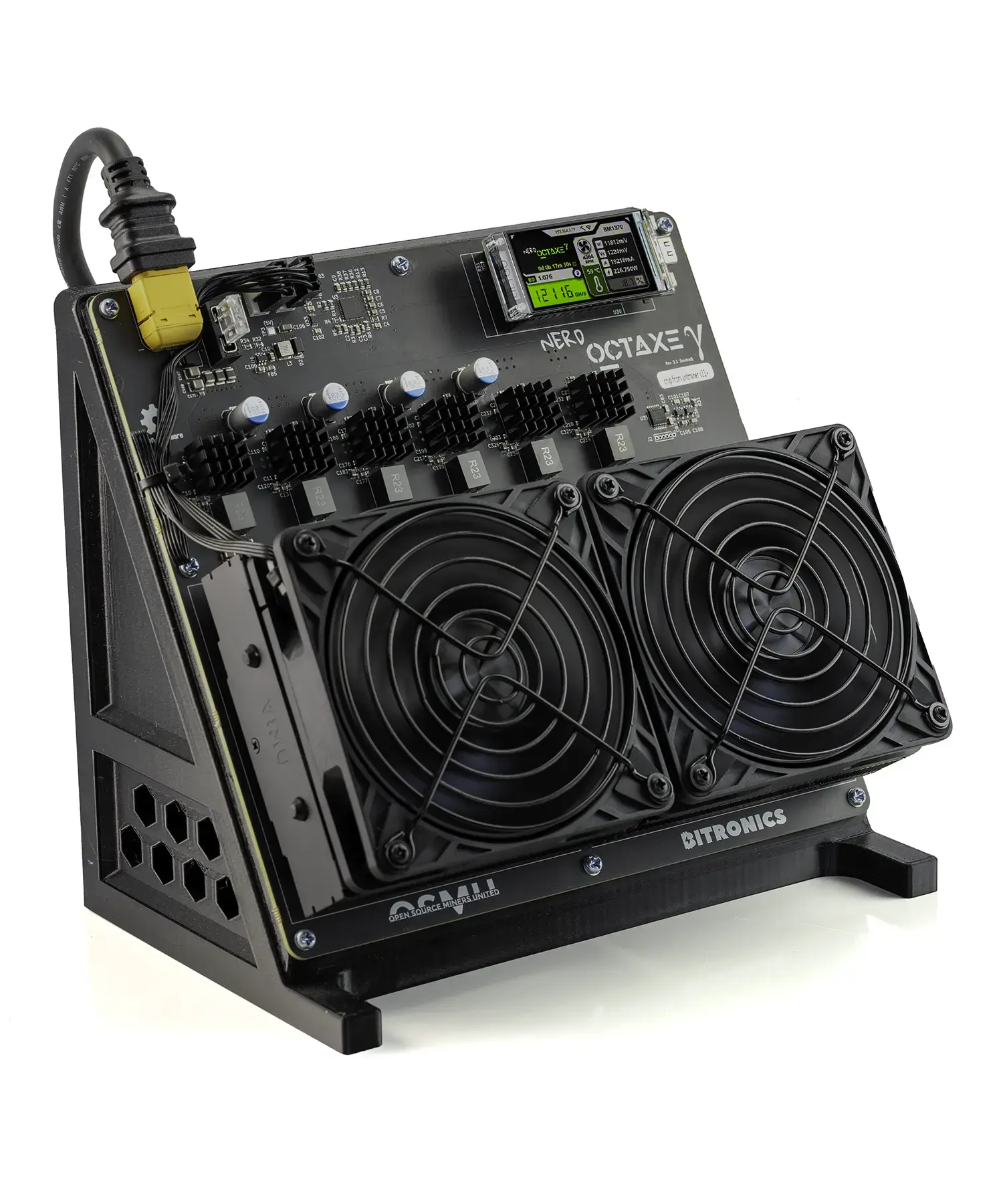
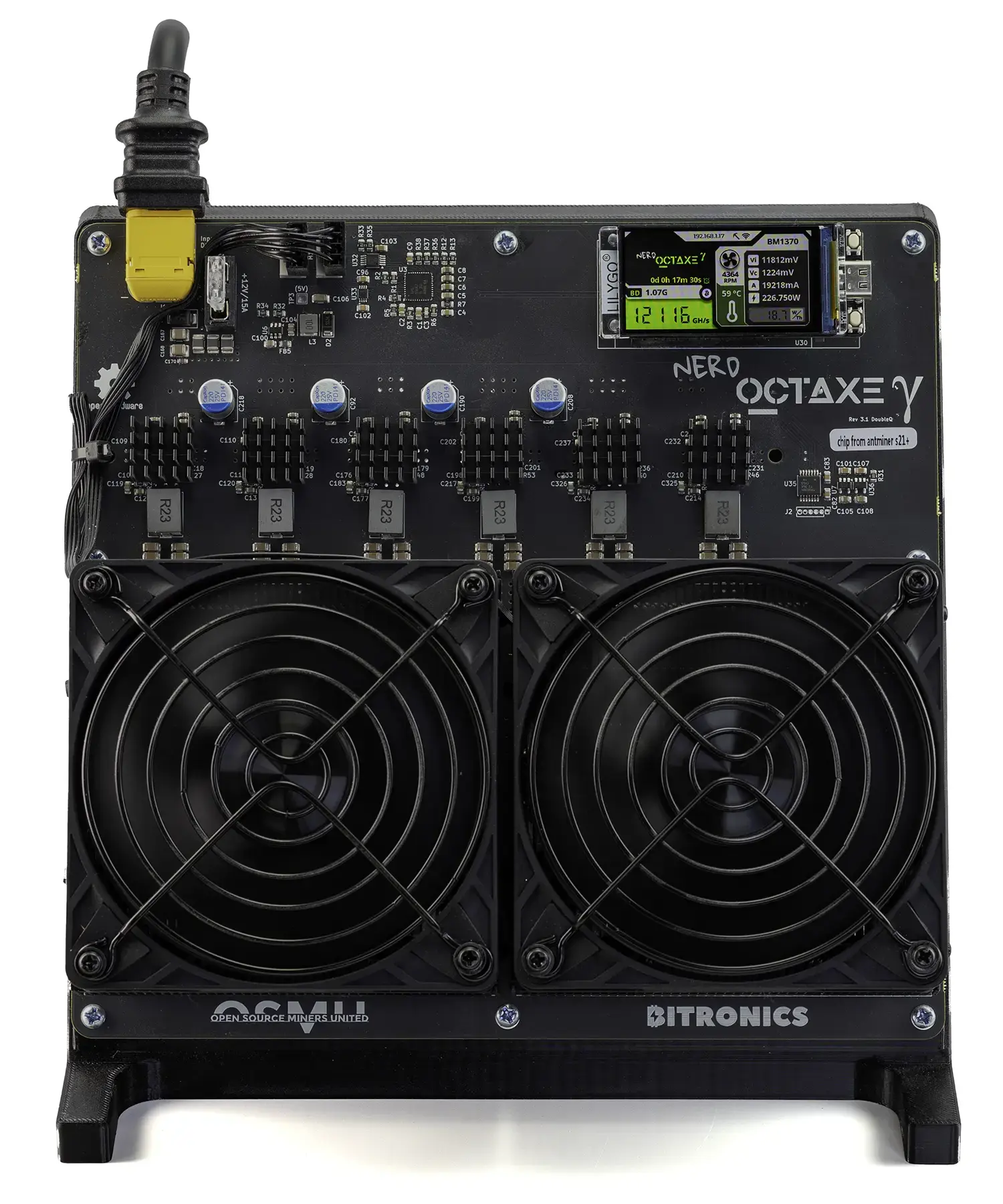
| Hashrate | 1.2 TH/s | 2.5 TH/s | 6 TH/s | 12 TH/s |
| Power | 24 W | 49 W | 98 W | 232 W |
| Efficiency | 20.0 J/THs | 19.6 J/THs | 16.3 J/THs | 19.3 J/THs |
| Dual Mining | No — select either BTC or BCH | No — select either BTC or BCH | Yes — simultaneous BTC/BCH | Yes — simultaneous BTC/BCH |
| Connectivity | Wi-Fi 2.4GHz | Wi-Fi 2.4GHz | Wi-Fi 2.4GHz | Wi-Fi 2.4GHz |
| Screen | OLED 0.91″ | OLED 0.91″ | Colour LED 1.9″ | Colour LED 1.9″ |
| Fan(s) | 1× 40mm silent fan | 1× 60mm silent fan | 2× 90mm silent fans | 4× 94mm silent fans |
| Noise level | ~35 dB | ~37 dB | ~33 dB | ~40 dB |
| Input voltage | 5V DC via barrel jack | 12V DC via XT30 connector | 12V DC via XT30 connector | 12V DC via XT60 connector |
| Power adapter | 5V 6A 30W power supply | 12V 6A 72W power supply | 12V 15A 180W power supply | Meanwell 12V 27.5A 330W |
| Dimensions | 10 × 6 × 11.5cm | 11.5 × 7 × 13cm | 16 × 9.5 × 17.5cm | 20.4 × 15 × 19cm |
| Weight | 145g | 282g | 523g | 1,378g |
| Firmware | AxeOS (open-source) | AxeOS (open-source) | NerdOS (open-source) | NerdOS (open-source) |
| First released | Aug 2024 | Feb 2025 | Nov 2025 | Jan 2026 |
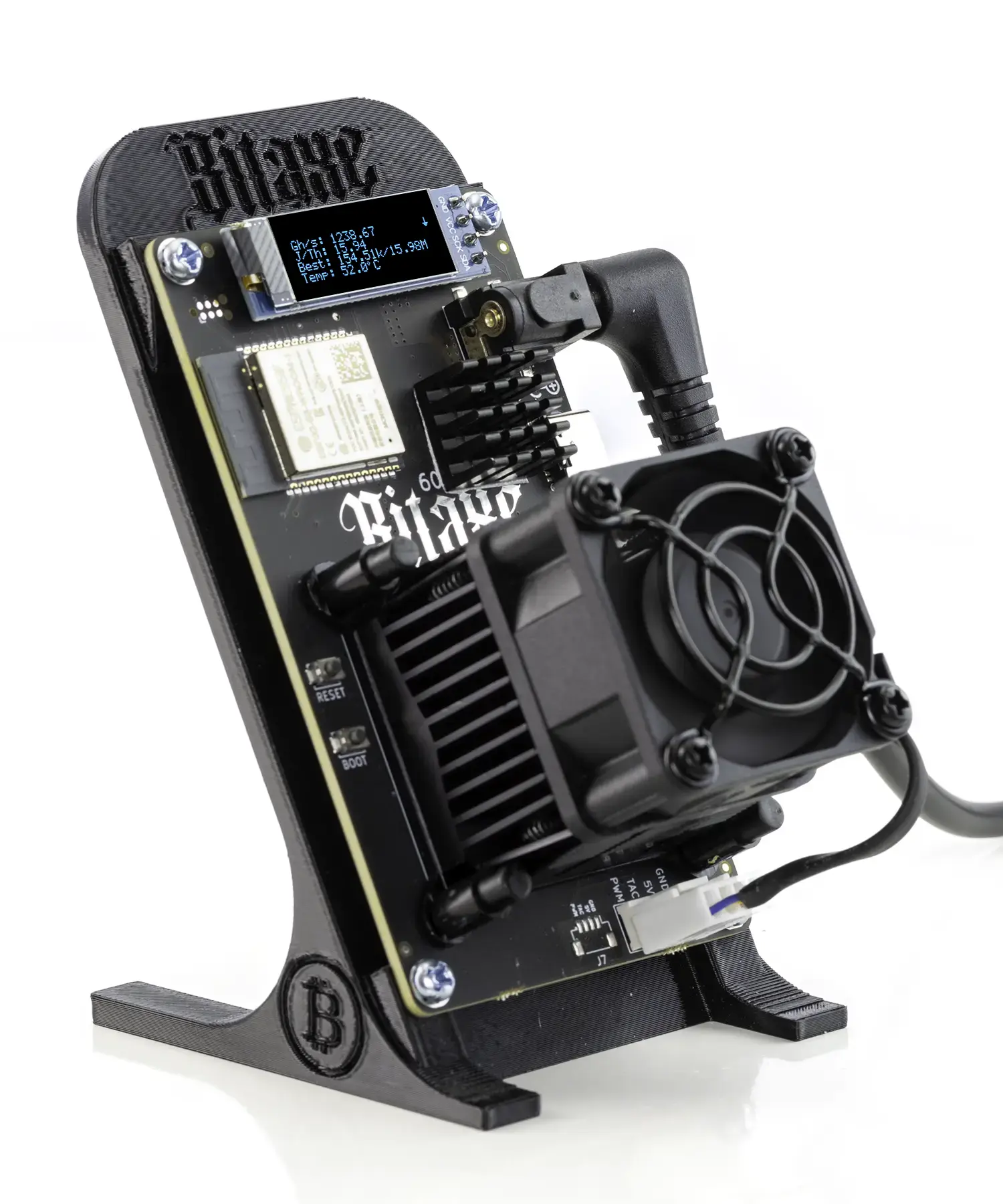
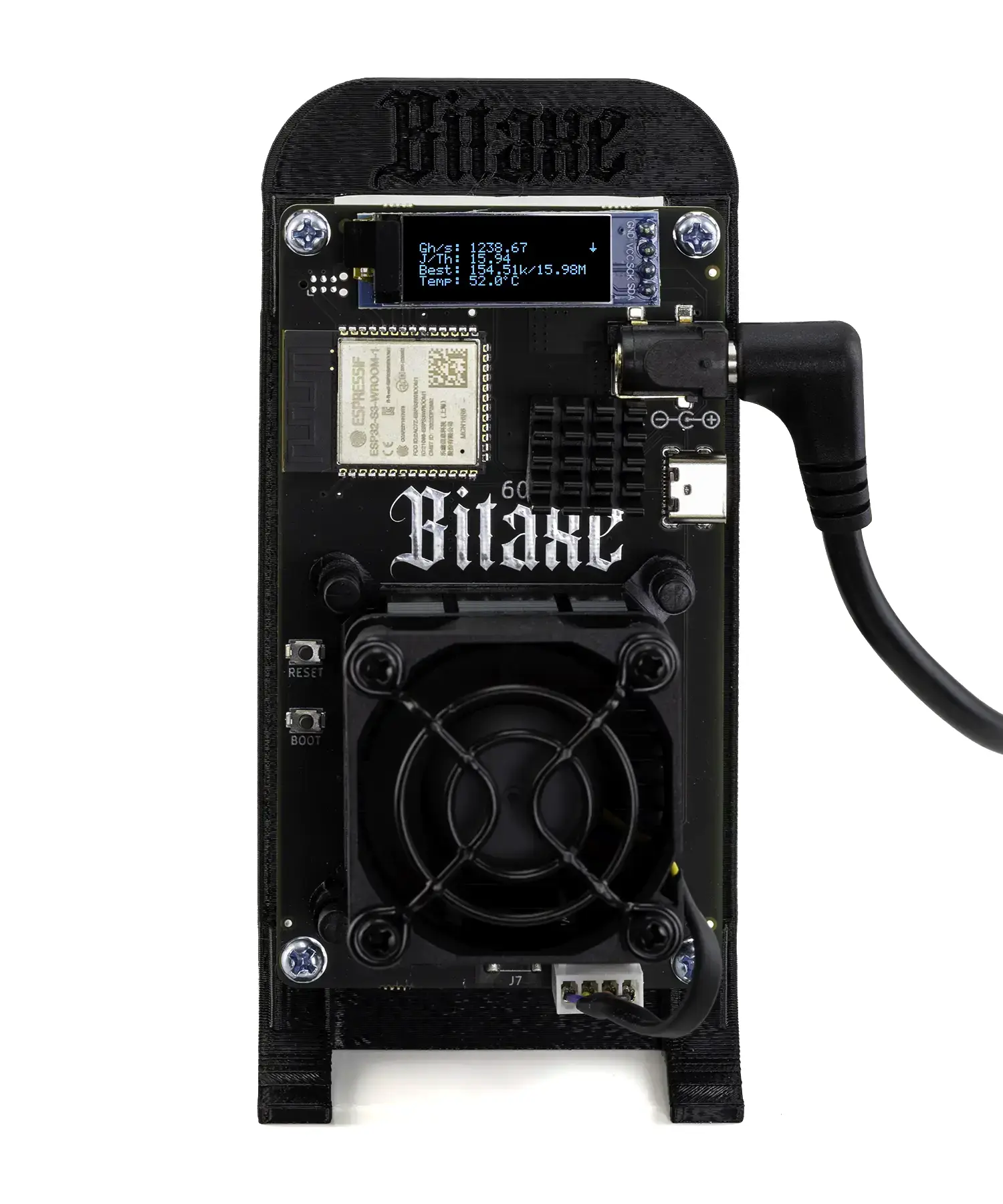
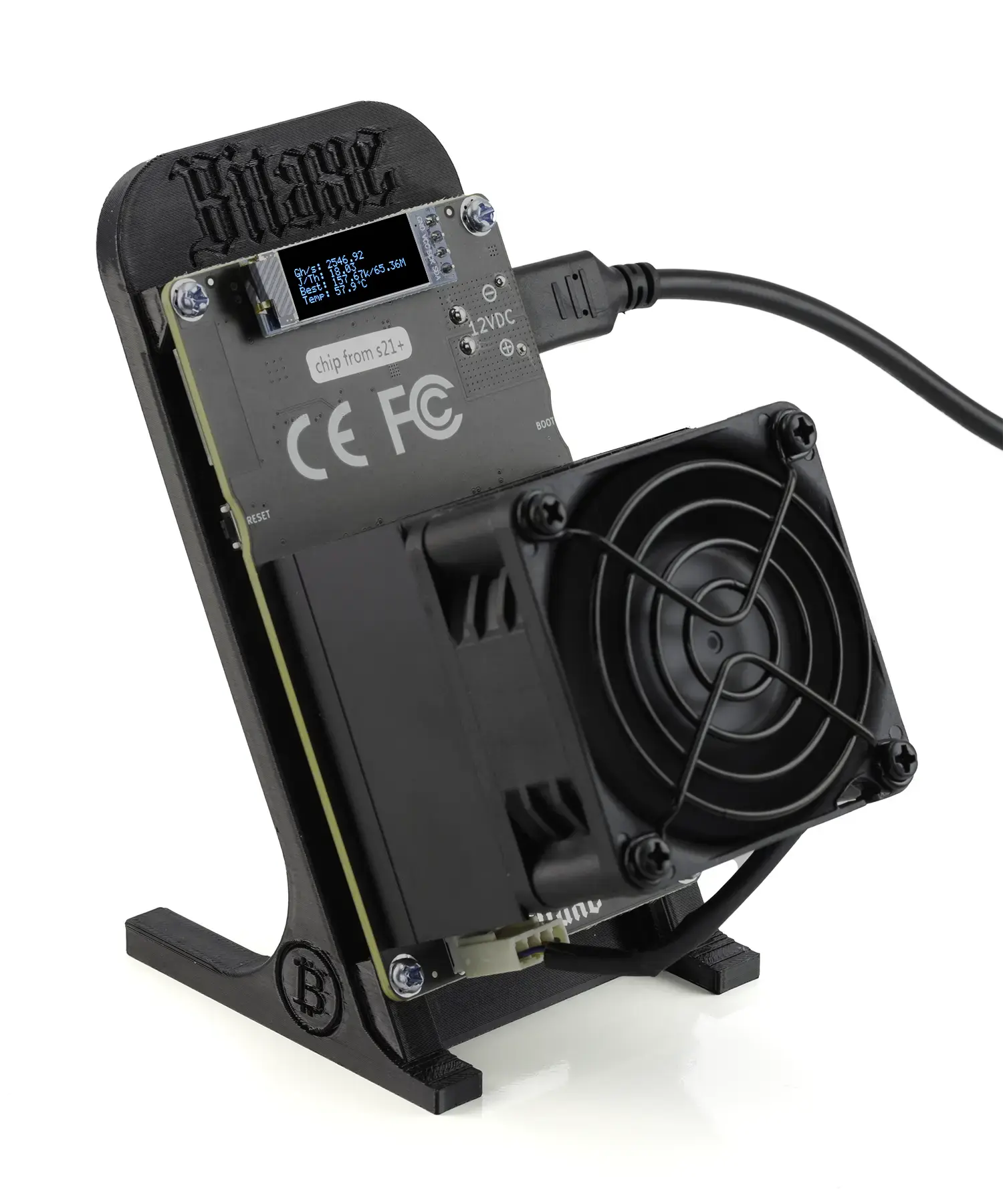
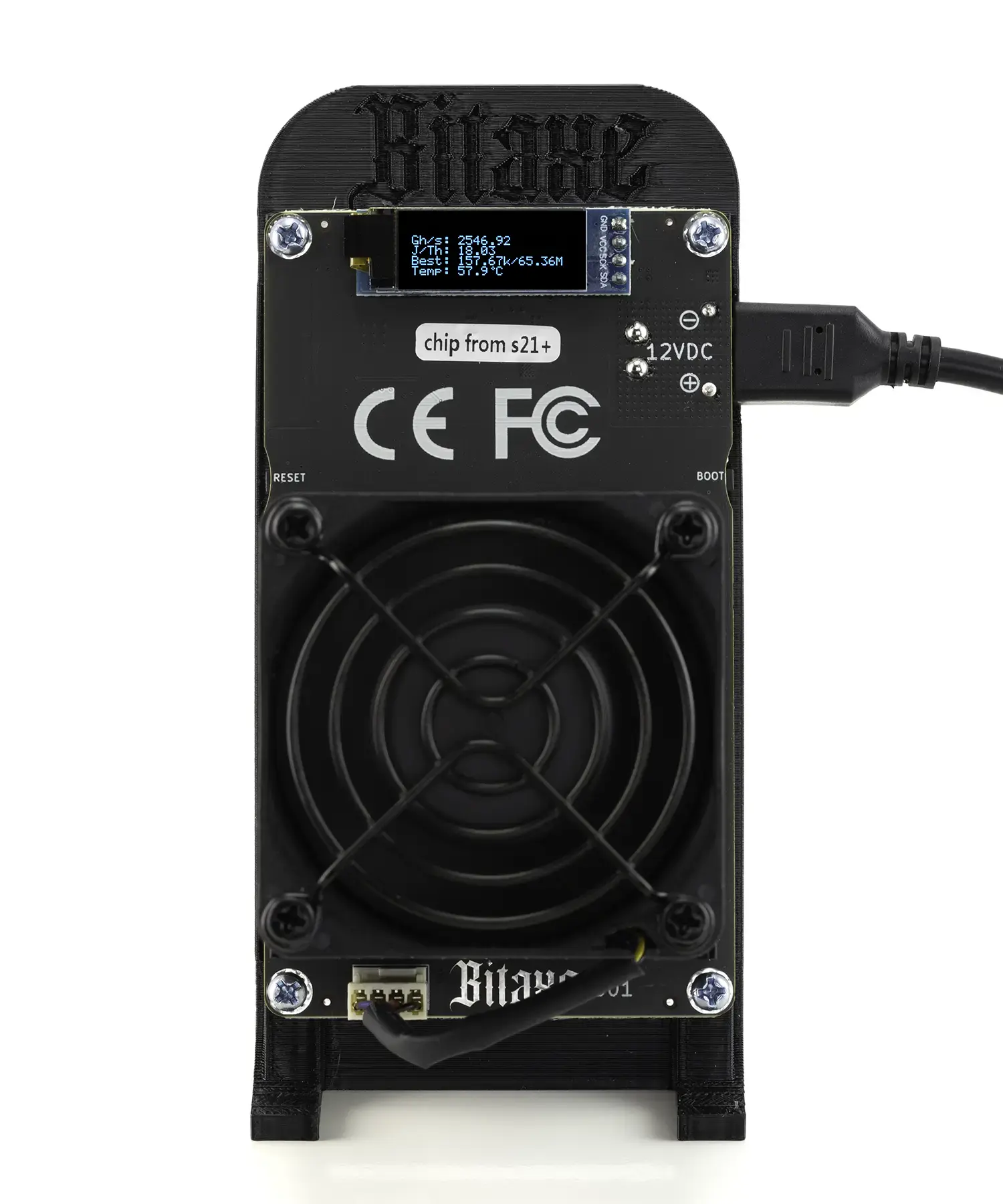
What the numbers in the table actually mean
A specification sheet is only useful if you know which lines matter. Here is what each row changes in practice, and where the differences between these crypto miners are real rather than cosmetic. Read it alongside the table and the choice usually makes itself.
The BM1370 ASIC inside every one of these crypto miners
Something the table does not show: all four machines are built on the same chip. The BM1370 is a 5 nm application-specific integrated circuit — an ASIC — designed to do exactly one thing, which is compute SHA-256 hashes as fast and as efficiently as physics allows.
That matters, because it explains why these numbers look the way they do. A general-purpose processor can do millions of different things and is therefore mediocre at all of them. An ASIC does one thing and is extraordinary at it. A modern desktop CPU mines Bitcoin at roughly 0.00002 TH/s; the smallest machine on this page manages 1.2 TH/s while drawing 24 W. That is not an improvement in degree, it is a different category of device.
The BM1370 ASIC is the same generation of silicon used in current industrial mining hardware. What separates a machine on this page from one in a data centre is not the quality of the chip but how many are fitted: an industrial unit packs hundreds, these crypto miners between one and eight.
This has a practical consequence when you read the table. Because every model shares a chip, the differences between them come down to the engineering around it — how many are installed, how well they are cooled, how cleanly they are powered. It also means the efficiency figures are directly comparable in a way they would not be if these were different chip generations competing on process node.
Hashrate: your share of every draw
Hashrate, measured in terahashes per second, is the number of guesses your machine makes every second as it searches for a valid block. The range on this page runs from 1.2 TH/s to 12 TH/s, a tenfold spread.
In solo mining that number is your odds, directly and proportionally: a 12 TH/s machine makes ten times as many attempts as a 1.2 TH/s machine. Our solo mining calculator turns any of these figures into a real chance of finding a block over a month, a year or three years, worked out against live network data.
This is the cleanest way to read the whole table: everything else is about what that hashrate costs you in electricity, noise and space.
Power draw: from a lightbulb to a games console
The four crypto miners draw 24 W, 49 W, 98 W and 232 W. Those numbers are easier to judge when you convert them into a monthly bill. At a European average of roughly EUR 0.25 per kWh, running continuously:
- 24 W is about 17 kWh a month, roughly EUR 4.30
- 49 W is about 35 kWh a month, roughly EUR 8.80
- 98 W is about 71 kWh a month, roughly EUR 17.60
- 232 W is about 167 kWh a month, roughly EUR 41.80
Check those against your own tariff, because electricity prices vary enormously across Europe. The important point is the shape of it: the entry-level machine costs less to run for a month than a takeaway pizza, and even the largest sits well below what most people spend on streaming subscriptions.
Efficiency: the row that rewards a close look
Efficiency, in joules per terahash, tells you how much electricity each unit of work costs. This is the row where the table stops being a simple ladder.
The 1.2 TH/s model runs at 20.0 J/TH, the 2.5 TH/s model at 19.6 J/TH, and the 12 TH/s model at 19.3 J/TH. Those are close enough to be considered equivalent. The outlier is the 6 TH/s model at 16.3 J/TH, which is meaningfully more efficient than everything else here, including the machine above it.
That happens because four chips share one well-designed power stage and one large cooling assembly, hitting a sweet spot between chip count and overhead. If your priority is the most hashrate per euro of electricity rather than the most hashrate outright, that row is the one to read twice.
Dual mining: one machine, two lotteries
The table splits cleanly here. The two smaller machines mine either Bitcoin or Bitcoin Cash — you choose which, and you can change your mind, but they work on one chain at a time. The two larger machines mine both simultaneously, dividing their hashrate between the two chains with no overhead loss.
That is possible because both chains use the identical SHA-256 algorithm, so the same work counts on both networks — and because the Bitcoin Cash network is far smaller, the same hardware represents a much larger share of it. If solo mining appeals to you because of the chance of actually finding a block, this is the row that moves the needle most.
The solo mining calculator shows exactly what that difference is worth at any hashrate, and lets you set the split between the two chains.
Noise: the specification that decides where it lives
The machines measure approximately 35 dB, 37 dB, 33 dB and 40 dB. These are not big numbers, but the differences matter more than they look, because the decibel scale is logarithmic and because your tolerance depends entirely on the room.
The 6 TH/s model is the quietest on the page at around 33 dB, despite having four times the chips of the entry-level machine. That is not a contradiction: it uses two 90 mm fans turning slowly rather than one small fan turning fast, and large slow fans move the same air with far less noise.
At the other end, the 12 TH/s model sits at about 40 dB — roughly the level of a domestic fridge. Perfectly liveable in a hallway, a home office or a utility room. Most people would not want it beside their pillow.
If the machine has to share a bedroom, look at the 33 dB and 35 dB options first. If it will live in a study or under the stairs, the noise row stops constraining your choice and you can pick on hashrate alone.
Cooling: one 40 mm fan, or four 94 mm
The fan row explains the noise row. The entry machine uses a single 40 mm fan; the second, one 60 mm; the 6 TH/s model, two 90 mm; and the 12 TH/s model, four 94 mm fans. Fan size is the single biggest lever on how a mining machine sounds, which is why the largest cooling assembly does not automatically mean the loudest device.
It also tells you something about longevity. Larger fans spinning slower run cooler and wear more slowly, and every chip on this page performs better when it is not fighting its own heat.
Screens: what you can see without opening a browser
The two smaller machines carry a 0.91-inch OLED display; the two larger ones a 1.9-inch colour LED screen. Every model exposes the same full dashboard in a web browser, so the screen is about convenience rather than capability.
In daily use it matters more than you would expect. A glance tells you the machine is hashing, how warm it is running and whether it is still connected to its pool — without finding a device, opening a browser and typing an address. On the colour screens of the dual-mining models, both chains are shown at once.
Connectors and power supplies
The entry machine takes 5 V through a standard barrel jack with a 30 W supply. The 2.5 TH/s and 6 TH/s models use 12 V through an XT30 connector, with 72 W and 180 W supplies. The 12 TH/s model uses 12 V through an XT60 connector, fed by a Meanwell 330 W industrial unit.
Two things are worth noticing. First, XT30 and XT60 are locking connectors from the radio-control world, chosen because they carry serious current without heating up or vibrating loose. Second, the largest machine’s 330 W supply feeds a 232 W load. That headroom is deliberate: a power supply run permanently at its limit is a power supply that fails early, and Meanwell is the brand you find inside professional equipment rather than in a bundled box.
Size and weight
Dimensions run from 10 x 6 x 11.5 cm to 20.4 x 15 x 19 cm, and weight from 145 g to 1,378 g. The smallest genuinely fits in a hand. The largest is about the size of a small desktop speaker and stays where you put it.
None of these crypto miners need a rack, a shelf rated for weight, or a dedicated circuit. They plug into an ordinary wall socket like any other appliance.
Firmware: AxeOS and NerdOS
The two smaller machines run AxeOS; the two larger, NerdOS. Every one of these crypto miners runs fully open-source firmware, updated in one click from the dashboard, and both are developed by active international communities rather than by a vendor.
This is worth more than it sounds. Open firmware means nobody can quietly redirect your hashrate, insert a developer fee, or abandon the device by ending support. You can read exactly what the machine does, and if you disagree with it you can change it.
Four generations, eighteen months apart
The release dates in the last row — August 2024, February 2025, November 2025 and January 2026 — show how quickly this hardware has moved. Each model builds on the one before it, which is why the newest machines are not simply bigger but better cooled and, in the case of the 6 TH/s model, meaningfully more efficient.
How Bitcoin solo miners work
Roughly every ten minutes, the Bitcoin network pays a block reward of 3.125 BTC to one single miner somewhere in the world. There is no second place and no partial credit.
Pool mining spreads that reward across thousands of participants, so you receive small, regular fractions. Bitcoin solo miners work the opposite way: your machine searches on its own account, and if it finds a block you keep the whole reward.
That makes solo mining a lottery, and we would rather say so plainly than dress it up in projections. Nobody should buy one of these crypto miners expecting an income — people buy them because a small, quiet device on a shelf is genuinely participating in the network, and because the odds are transparent rather than promised.
To see what those odds actually are for any machine on this page, use the solo mining calculator.
Which of these crypto miners is right for you
If this is your first machine, start at 1.2 TH/s. It costs the least to buy and about EUR 4 a month to run, it is quiet enough for any room, and it teaches you how pools, addresses and dashboards fit together. Plenty of people add a second one later rather than replacing it.
If you want the most work per unit of electricity, the 6 TH/s model is the standout on this page. It is the most efficient at 16.3 J/TH, the quietest at around 33 dB, and it mines both chains at once. For most buyers weighing everything together, it is the strongest all-round choice here.
If you want the best odds you can reasonably run at home, the 12 TH/s model is the top of the range: eight chips, dual mining, and an industrial power supply specified for continuous duty. Give it somewhere its 40 dB will not bother anyone.
If you want a second machine rather than a bigger one, that works too, and the reason is worth understanding.
Building a crypto mining farm at home
Solo mining has an unusual property: two independent machines are exactly as good as one machine of twice the hashrate, because nothing is lost by splitting your hashrate across separate devices.
That makes a crypto mining farm at home simple to build incrementally. There is no controller to buy, no rack to assemble and no minimum size. Each unit needs a wall socket and Wi-Fi, and it works independently of the others. Several people run one machine per room, partly to spread the heat and noise, partly because adding one at a time is easier to justify than a single large purchase.
Three practical points if you go that way. Keep an eye on total draw if several share one circuit — four of the largest machines is under 1 kW, comparable to a kettle, but worth knowing. Give each machine air; they are passively arranged but they still need somewhere for warm air to go. And remember the heat is not wasted in winter, which is one reason home mining is more popular in northern Europe than the raw economics alone would suggest.
What happens after your machine arrives
Every model on this page ships assembled, tested and preconfigured for low-latency European pools. There is no soldering, no flashing and no command line.
Connect it to power, join it to your 2.4 GHz Wi-Fi network, open the dashboard in any browser on the same network, and paste in your Bitcoin address — plus a Bitcoin Cash address on the dual-mining models. It begins hashing immediately. Most people are running within five minutes of opening the box.
From there it wants very little attention. Check the dashboard occasionally, apply firmware updates when they appear, and clear dust from the fans every few months. Each machine comes with an illustrated quick start guide, a full online manual, a 12-month warranty and support in English and Italian.
Being honest about what these crypto miners will not do
They will not pay your electricity bill through mining income. They will not make you money on a predictable schedule. If a home miner is sold to you with a projected monthly return, that projection is either a pool payout in disguise or a fiction.
What they will do is put you genuinely, verifiably inside the Bitcoin network with hardware you own and firmware you can read, for the running cost of a lightbulb. Every ten minutes there is a draw, and your machine is in it. That is the whole proposition, and it is enough of one that these crypto miners keep selling out.